
Hi all, here is a series I originally posted on linkedin as a soft introduction to the wonderful world of pharmacometrics. A lot of these posts revolve around a simple coffee simulator I built for the fun of optimizing your coffee dosage. Hope you enjoy learning as much as I did making this series!
Link to coffee simulator: https://sites.google.com/view/singaporepharmacometrics/apps
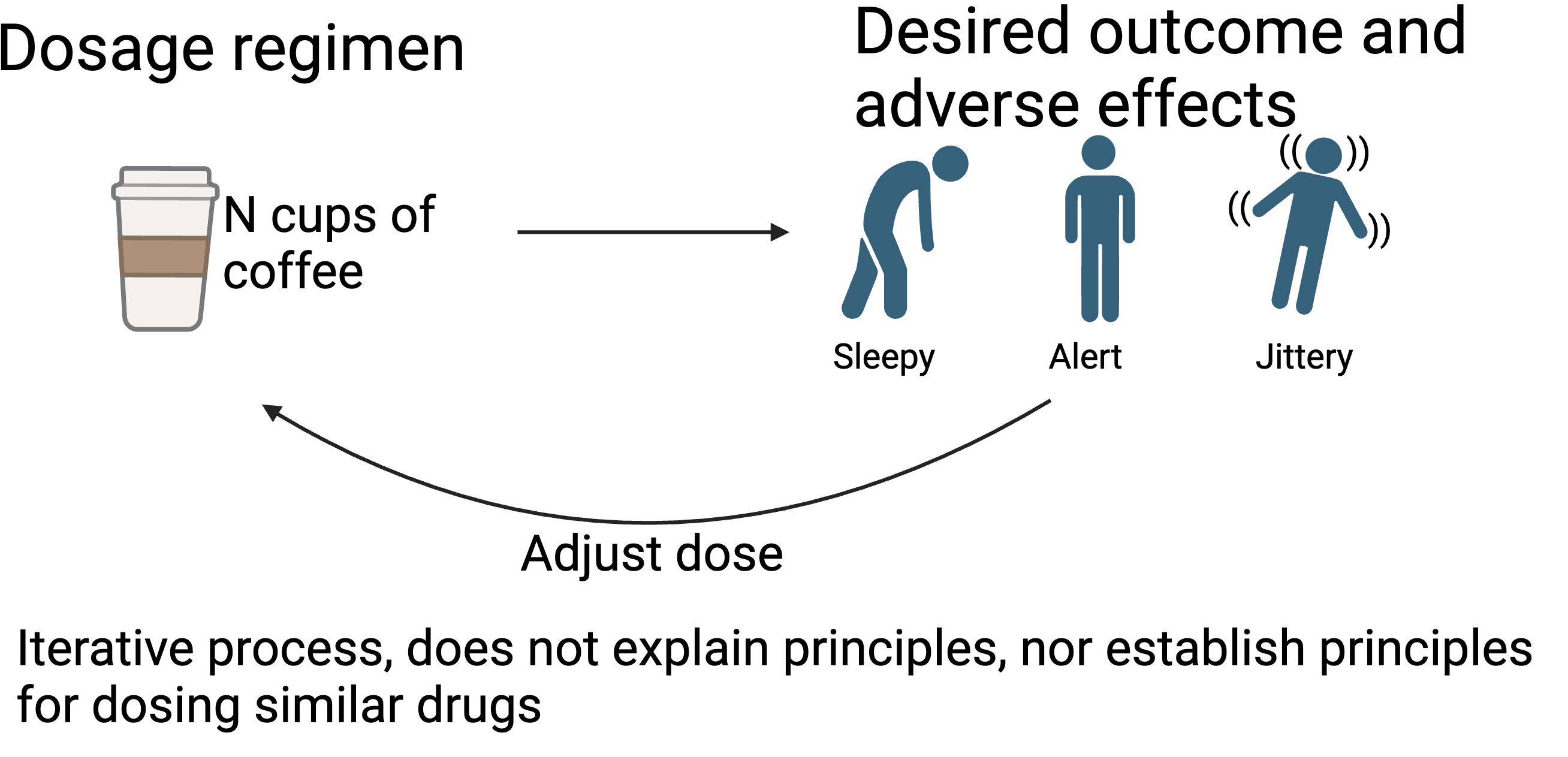
With or without my coffee simulator app, most of you would have already optimized your own caffeine dose after some trial and error. After all, it is easy to individualize the dose by just figuring out when you would be sleepy and decide to take another cup. However, as modern-day philosopher Marshall Mathers once said, “You don’t get another chance, life is not Nintendo game.” For many other drugs, such an iterative process can be highly detrimental if a safe and efficacious dose is not found quickly.
Knowing the pharmacokinetic profile of a drug allows us to establish rules on how the dosing should be conducted. i.e. we know how fast the drug is absorbed and eliminated, so we know how often to dose such that we can achieve drug levels above a particular concentration of the drug.
These models also help us to test covariates such as age, gender and pharmacogenomics (that a number of you mentioned previously) to understand where variation in a population can occur. In the case of our caffeine model, the developers of the model found that clearance of caffeine was significantly faster in smokers than nonsmokers, hence the additional option of smoking status.
Modeling and simulation thus helps us to characterize the drug’s exposure in our body and optimize safe and efficacious doses with much less trial and error required.


 Singapore Pharmacometrics