
In my previous life as a pharmacist, many patients used to ask if it was safe to take two medications they were prescribed together. Unless otherwise stated e.g. explicit instructions were given to take the medications at least 2 hours apart, or if you take drug A not to take drug B as well, the medications prescribed are generally safe to be taken together. This is because the pharmacist has already checked for potential drug-drug interactions (DDI) before filling the prescription.
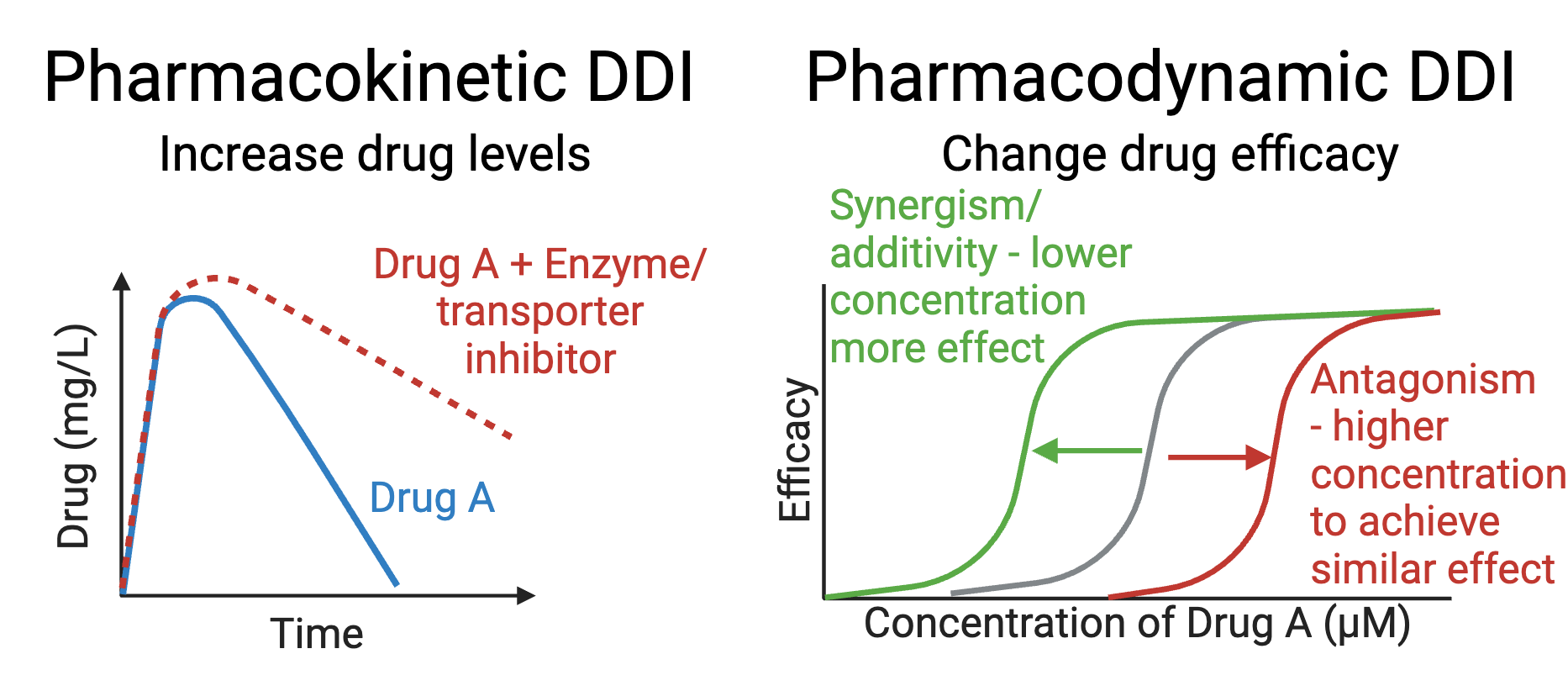
Similar to one of my previous posts on pipagao-drug interactions , there are broadly 2 categories of DDI
- Pharmacokinetic (PK) DDI – drug A influences drug B’s levels in the body when both are taken together e.g. an antibiotic ciprofloxacin increases high cholesterol medication, simvastatin’s levels, by inhibiting liver enzymes that break simvastatin down. This leads to a higher risk of side effects from simvastatin.
- Pharmacodynamic (PD) DDI – drug A has additive, antagonist or synergistic impact on drug B’s effectiveness/toxicity e.g. alcohol and sleeping pills can be a dangerous combination as alcohol increases the drowsy effect of the sleeping pill exponentially.
However, not all DDIs are bad. DDIs can also be used to improve therapy.
For PK DDI, a well-known example is Paxlovid which is used to treat COVID-19. Paxlovid is actually a combination of 2 drugs, nirmatrelvir and ritonavir. While both are antivirals, ritonavir has the additional effect of inhibiting liver enzymes that break down nirmatrelvir, allowing nirmatrelvir to stay longer in the body and exert its antiviral effect.
For PD DDI, we similarly have a common example with Augmentin, a broad spectrum antibiotic often prescribed for bacterial (not viral) infections. Augmentin is also a combination medication of amoxicillin and clavulanic acid. Amoxicillin by itself is useful for killing bacteria. However, it can be easily inactivated by an enzyme called beta-lactamase, which are produced by several bacterial strains. Clavulanic acid is a beta-lactamase inhibitor and thus helps amoxicillin to become effective against these beta-lactamase producing bacteria.
DDIs are thus not always things to avoid, but require good pharmacological knowledge to steward well for safe and effective therapies. But as always, when in doubt, just ask your pharmacist!


 Singapore Pharmacometrics