
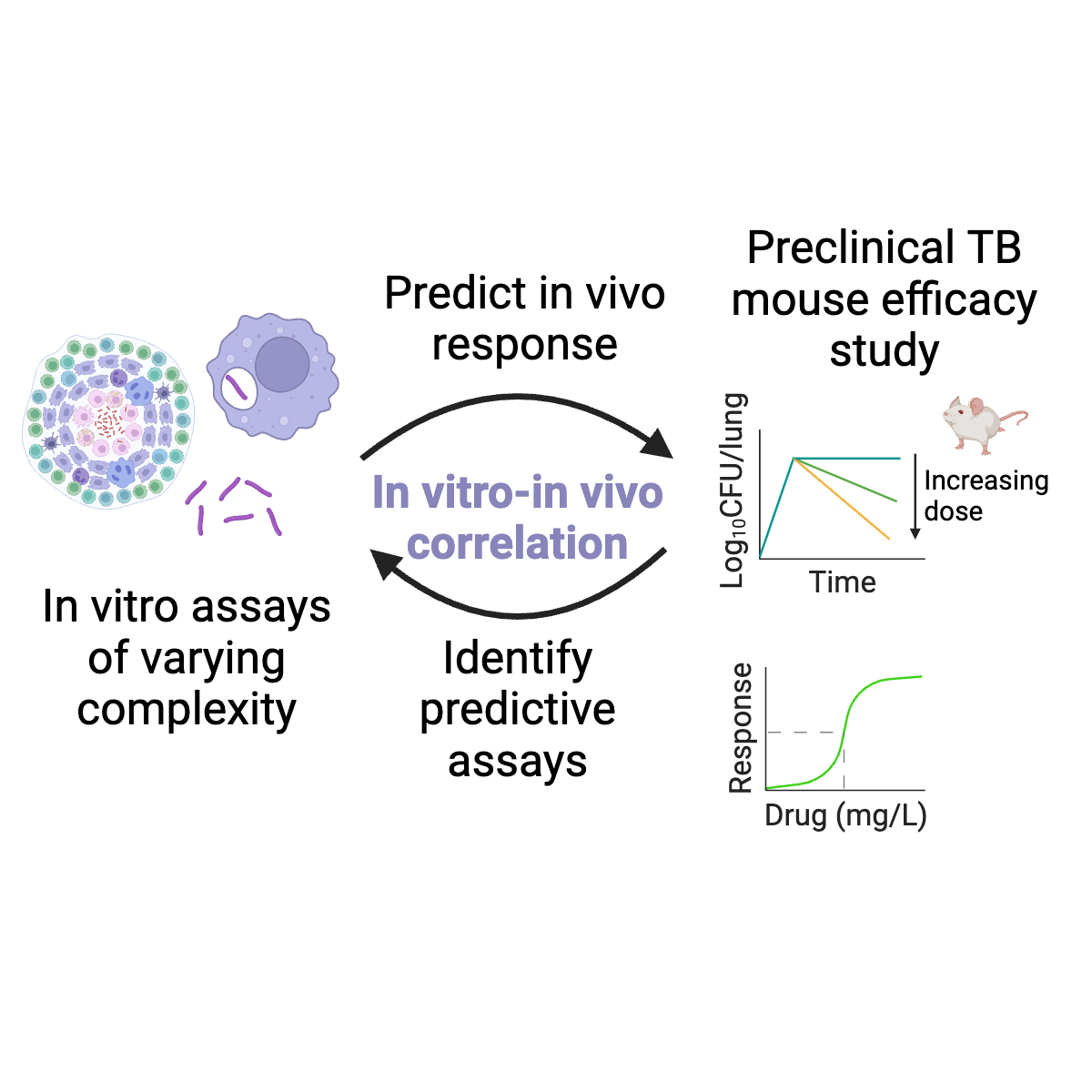
Drug development often follows a series of experiments of exponentially increasing costs. After identifying a target and a few hits, novel drugs are then tested in large scale against in vitro assays e.g. bacterial kill in a 96 well plate, for efficacy. After this, the most promising hits are prioritized for animal testing. Depending on who you ask though, the most promising hit can differ, depending on what kind of in vitro assay was done. This is a problem in drug development for tuberculosis, the top infectious disease killer in the world, where multiple in vitro assays exist, but it remains unclear which ones are informative for further translation into animal studies.
In vitro assays are also hard to compare to efficacy in animals, as drug dosing in animals is dynamic, with a rise in concentration as drug is absorbed orally, before dropping as the drug is cleared. In vitro assay readouts however, tend to focus on a single potency value e.g. concentration to achieve 50% effect, (EC50) instead. Thankfully, with PK-PD modeling, we can account for these dynamic drug levels in animals and measure an in vivo potency. This allows us to compare drug efficacy between systems, and by doing so, select the best in vitro assay, or combination of assays that are informative of drug efficacy in animals.
These informative in vitro assays can then be used to predict drug efficacy of more novel compounds in animals when incorporated back into a PK-PD model.
Read all about it here https://www.cell.com/iscience/fulltext/S2589-0042(25)00192-0


 Singapore Pharmacometrics